A year into the government’s flagship reading intervention, millions of Filipino students are still struggling to meet basic literacy standards. New data from the Second Congressional Commission on Education (EDCOM 2) reveals that despite measurable progress in School Year 2025–2026, one out of every two learners still could not read at their grade level by the time the school year ended in March 2026.
The Department of Education (DepEd) tracked reading proficiency through three separate assessments depending on grade level:
- CRLA (Comprehensive Rapid Literacy Assessment) — used for Grades 1 to 3
- Phil-IRI (Philippine Informal Reading Inventory) — covering Grades 4 to 10
- SHS-LNA (Senior High School Literacy and Numeracy Assessment) — piloted for the first time with Grade 11 students
Progress Is Real, But Not Enough
There’s no question that students improved over the course of the year. Back in June 2025, only 19% of learners in Grades 1 to 10 were reading at or above grade level. By March 2026, that figure had climbed to 48% — a 29-percentage-point increase in a single school year.
That sounds promising, until you look at what remains. Around 3 million out of 16.5 million assessed learners are still stuck in non-proficient reading categories. At the start of the year, four in ten students were tagged as Struggling Readers. Many of them never fully caught up.
Some Regions Left Far Behind
The national numbers obscure deeper divides. EDCOM 2 found that students in Region II, Region VII, and Region IV-B had nearly twice the proportion of struggling readers compared to higher-performing areas such as NCR, Region III, and CAR.
These regional gaps point to something that test scores alone can’t fix — uneven access to quality instruction, trained teachers, and learning resources across the country.
Senior High School: The Most Alarming Numbers
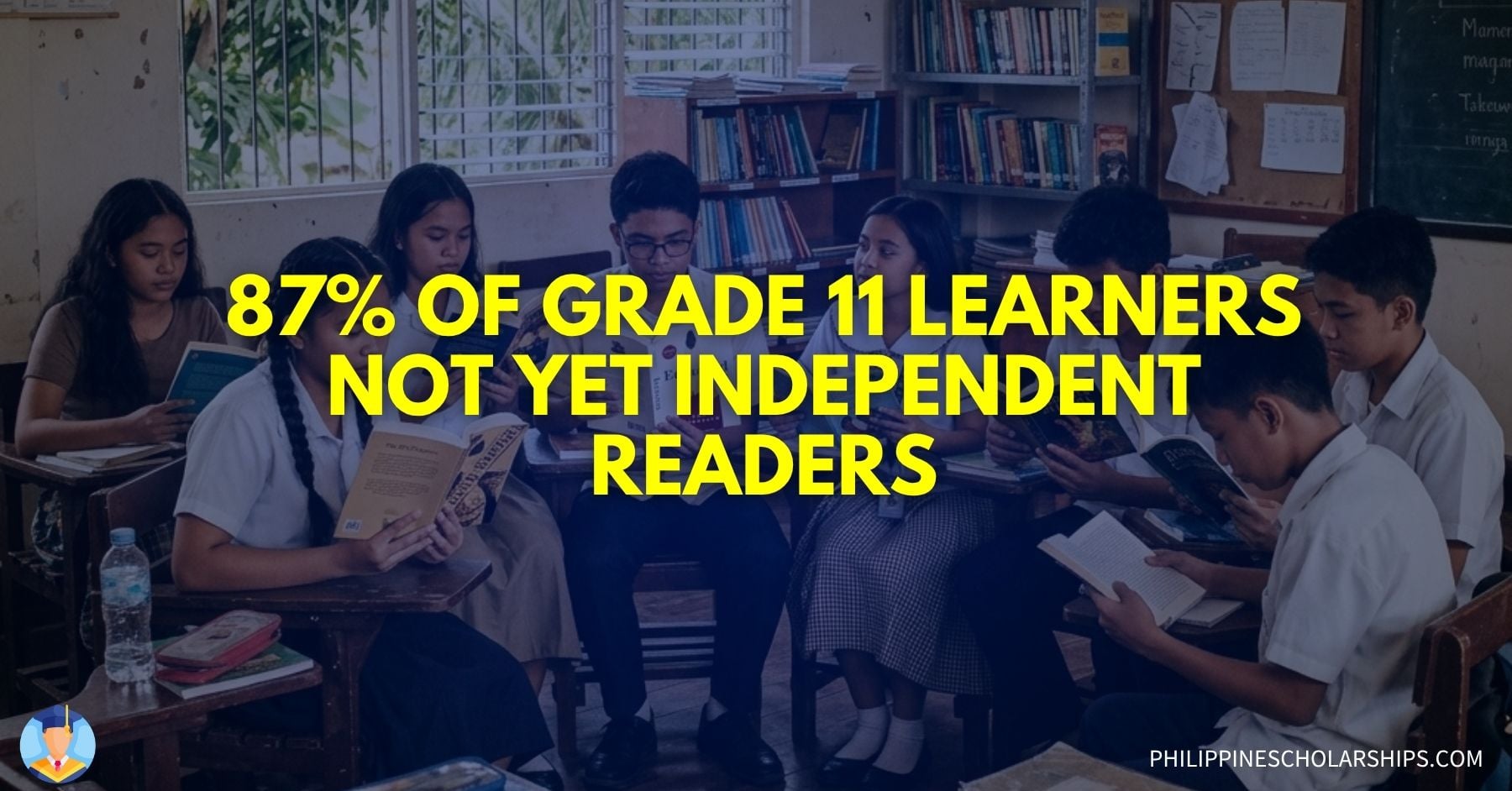
If there’s one finding that should set off alarm bells, it’s this: 87% of Grade 11 students who took the SHS-LNA pilot assessment are not independent readers. That means only about 1 in 8 senior high students can read and make sense of a text on their own — without guidance from a teacher.
The breakdown is sobering:
- 58.9% scored at the Frustration level, meaning they cannot handle grade-level material even with support
- 28.5% are at the Instructional level, able to follow along only when a teacher is present
These are students who are months away from graduating high school.
The Road Ahead
EDCOM 2 Executive Director Karol Mark Yee acknowledged the hard work behind the year’s gains but was clear-eyed about the challenge still facing the system.
“Moving forward, our task now is to design specialized supports for our students in high school, and to better differentiate interventions to help our students actually reach grade level readiness,” Yee said.
He added that the data now gives DepEd a concrete baseline to work from as it rolls out the ARAL Summer Program and heads into the second year of full implementation. The progress is real — but so is the urgency.