Students across the Philippines can now apply for the Peace Corps Alumni Foundation for Philippine Development (PCAFPD) Undergraduate Scholarship, a program designed to help deserving Filipinos achieve their college education. It supports students with strong academic performance, financial need, and a commitment to serving their communities, with applications open until 30 September 2026.
The PCAFPD 2026 Undergraduate Scholarship provides financial assistance to qualified undergraduate students, helping ease the cost of pursuing a college degree. Through this support, the program aims to give more deserving students the opportunity to complete their education and build a brighter future.
Benefit
Awardees receive a package designed to remove the usual roadblocks to a degree:
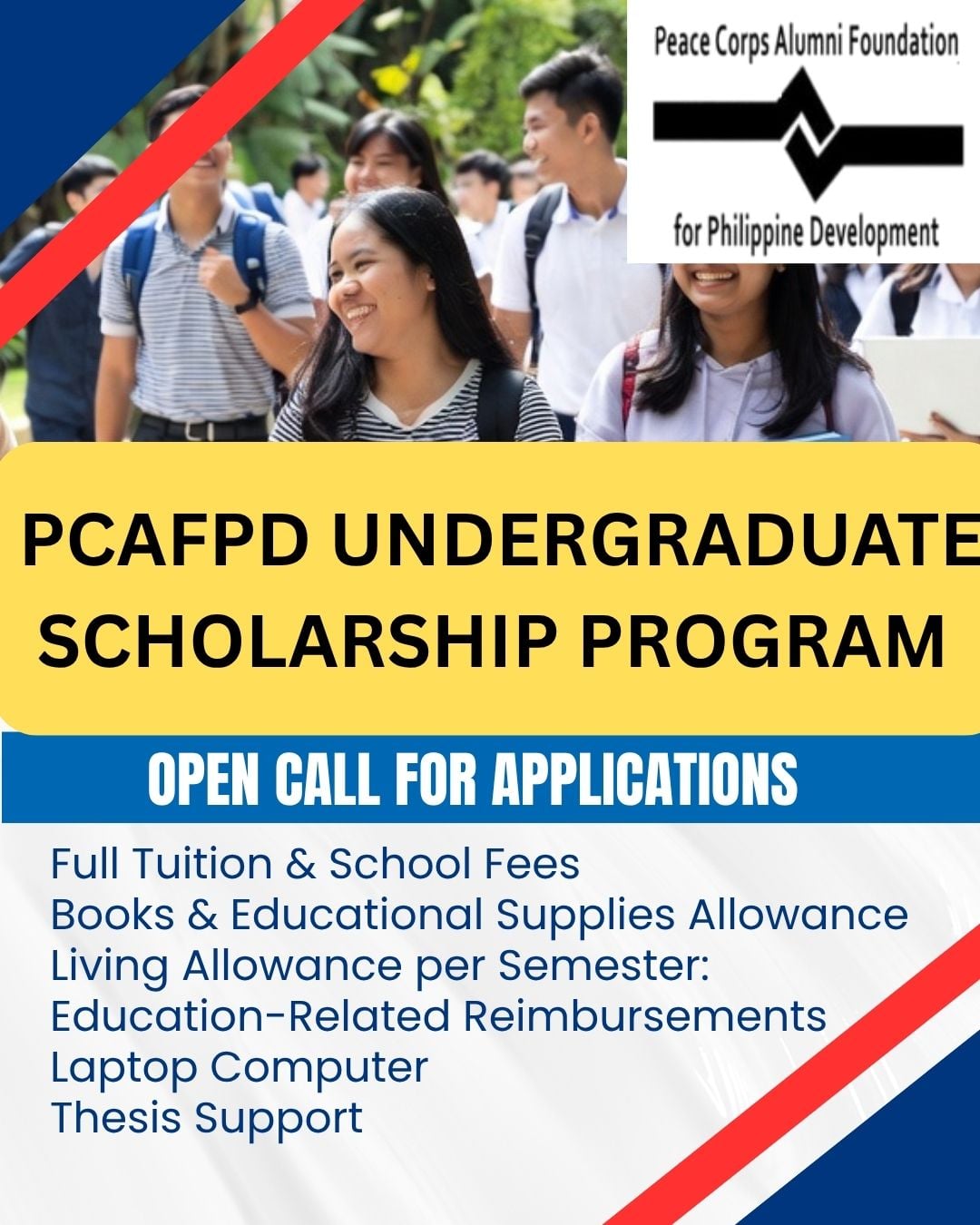
- Full tuition and school fee
- An allowance for books and educational supplies
- A living allowance each semester
- Reimbursement for approved education-related activities
- A laptop computer provided by the Foundation
Qualifications
- Must be a citizen of the Republic of the Philippines.
- Must be a current Grade 12 Senior High School student, a high school graduate who is not currently enrolled, or a first-year college student.
- Must maintain a good academic record.
- Must demonstrate leadership skills and active involvement in community service or volunteer activities.
- Must show proof of financial need, with priority given to applicants from low-income households.
- Must pursue a degree program that has the potential to contribute to the development of the Philippines.
- Must be committed to serving the country after graduation. This scholarship is intended for students who plan to contribute to the Philippines and is not designed for those planning to work abroad.
Scholarship Obligations
To maintain the scholarship, scholars must comply with the following requirements:
- Enroll in a full academic load unless approved for part-time study.
- Complete the degree within the prescribed duration set by the college or university. Scholars approved for part-time study must finish their degree within one and a half times the normal program length (e.g., a two-year degree must be completed within three years).
- Submit an official transcript of grades at the end of every semester.
- Maintain passing grades throughout the scholarship period.
- Submit a reflection essay at the end of each semester describing their academic experiences and personal growth.
- Maintain regular communication with the PCAFPD Manila team.
- Inform the Foundation immediately if awarded another scholarship or educational funding. The Foundation may adjust the scholarship amount to allow more deserving students to receive assistance.
- Obtain prior approval before transferring to another degree program or educational institution if they wish to retain the scholarship. Requests must be made no later than the first semester of the second year of the program. Failure to obtain approval may result in the termination of the scholarship.
- Participate in PCAFPD scholar activities and networks, including mentoring programs, scholar meetings, alumni events, and other selected activities.
Requirements
Applicants are advised to gather every requirement before starting the online form. and submit them along with their application. Handwritten letters will not be accepted.
Grades and GPA. Submit your most recent report card or transcript, and make sure it shows a cumulative GPA. Grade 12 students provide their Grade 11 records, SHS graduates submit their Grade 12 report cards or transcript, and first-year college students include their latest college grades.
Three essays. Every applicant writes three essays, each between 200 and 400 words and written in English. The topics ask you to reflect on:
- The course you plan to study and how your education will help your country develop
- A personal hardship you’ve overcome, or an event that shaped your character
- At least two examples of volunteer work and what they taught you about leadership and service
Income certification. Provide the latest BIR Income Tax Return (ITR) of your parents, guardians, or yourself if you’re working. If no ITR is available, you may submit a Certificate of Indigence from your Barangay or an Affidavit of Non-filing instead.
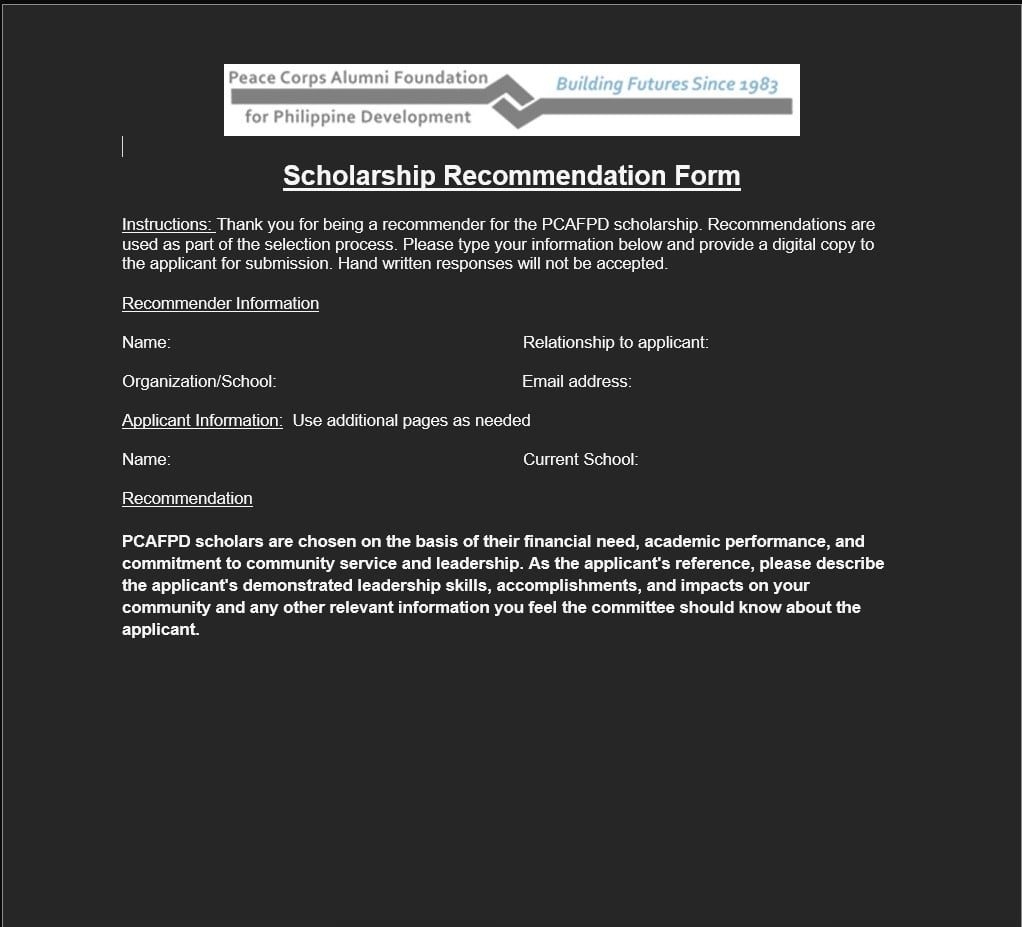
Two recommendation forms. Both must come from non-relatives. Accepted recommenders include teachers, school officials, your Barangay captain, religious leaders, civic leaders, or Peace Corps Volunteers. One key rule: handwritten letters will not be accepted, so recommenders should complete the official form digitally.
Deadlines and Reminders
Applications close on September 30, 2026. Incomplete submissions will not be processed, so double-check every requirement before you send yours in. All files must be converted to PDF and kept under 5MB each. The final list of accepted scholars will be announced on the official website in.
For students ready to take the next step toward their education, this scholarship could turn a long-held goal into reality.
Summary
The PCAFPD 2026 Undergraduate Scholarship is now open, giving Filipino students a chance to fund their college education. The program supports learners who show strong academics, real financial need, and a commitment to serving their communities.
Grade 12 students, senior high school graduates not yet in college, and first-year college students may apply. Applicants must prepare several documents: their latest grades showing a cumulative GPA, three essays of 200 to 400 words each in English, income certification such as a BIR ITR or a Certificate of Indigence, and two recommendation forms from non-relatives like teachers or community leaders. Handwritten letters won’t be accepted.